Published · Huiqiao Industrial

In this guide
- Why a container can develop condensation
- Panel structure and bonding still matter
- Pack dry material using a defined moisture-control plan
- Use a pre-shipment checklist
- Buyer checklist
Why a container can develop condensation
Heat, humidity and temperature changes
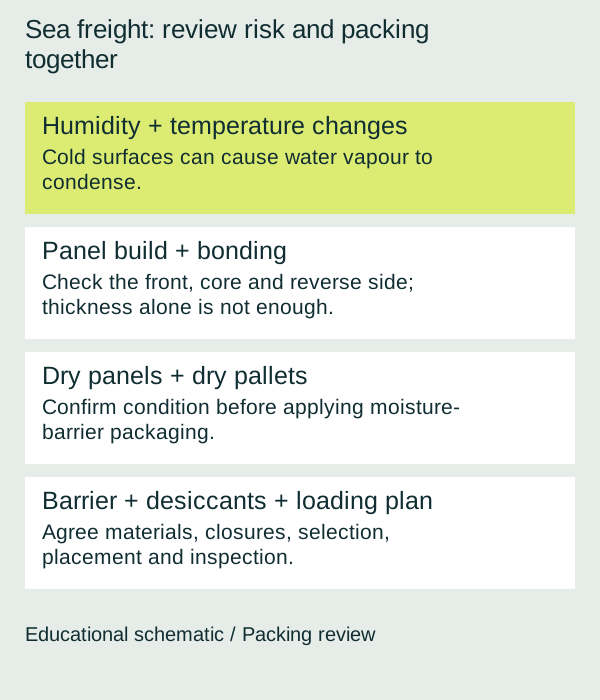
Warm, humid conditions at packing and changing temperatures during sea transport can affect condensation risk. Water vapour may condense when it meets a sufficiently cold surface, including the inside of a container roof. Moisture can come from cargo, timber packing and the conditions during loading; it is not necessarily proof of a container leak. Source: UNECE CTU Code: Annex 3, condensation prevention.
Review the route and handling conditions
Tell the packing team the origin, destination, expected storage and shipment route. Ask how goods will be protected during loading, transit and receiving. A moisture-control plan should address the conditions of the actual shipment rather than rely on a generic wrapping description.
Panel structure and bonding still matter
18 mm is an example, not a shipping guarantee
18 mm is only a substrate thickness example. It is not a guarantee against warping. Review front-and-back construction, core condition, component dimensions and bonding for the intended application.
Balanced front-and-back construction
Specify the decorative face, core and reverse-side finish or balancing layer. “Balanced” should be defined by the proposed construction and reviewed with the supplier; it does not necessarily mean identical-looking finishes on both faces. A balanced front-and-back construction can help control internal stresses, but it does not by itself guarantee flatness or prevent warping. Actual behaviour also depends on the core, bonding, component dimensions, moisture condition, and storage and transport conditions. Ask for relevant product-specific stability evidence rather than assuming a thickness or material name is enough.
Bond quality
Confirm the adhesive and lamination route for the selected film and board. Agree checks for bubbles, lifting and edge condition, and any bond-performance evidence required by the project. A good packing plan does not correct an unsuitable panel build.
Compliance and transport performance are separate
Formaldehyde compliance is not the same as shipping durability. An emission report concerns a specified test and sample; it does not establish resistance to condensation, warping or bond damage in sea freight. Keep these questions separate in supplier review.
Pack dry material using a defined moisture-control plan
Dry panels and dry pallets
Check the moisture condition of panels, pallets and timber packing before packaging using an agreed method and material-specific acceptance criteria. Record the checks before applying moisture-barrier packaging. A clean-looking pallet is not proof that it is dry. Do not seal wet panels, pallets or timber packing inside the package. Source: UNECE CTU Code: loss prevention measures.
Moisture-barrier packaging
Discuss the barrier material, closures, seams, edge protection and handling method for the panel bundle. Ask what the proposed wrap is intended to control and how it will be checked. A loosely applied protective film is not automatically a sealed moisture barrier. Select the moisture-barrier arrangement for the actual cargo, route and transport duration; it cannot guarantee that condensation or warping will be eliminated. Source: UNECE CTU Code: loss prevention measures.
Desiccants
Choose type, quantity and placement with the packing provider for the moisture load, package, route and duration. Desiccants have finite capacity and do not make wet panels or wet packing acceptable. Secure them so their use does not damage the goods. Source: UNECE CTU Code: loss prevention measures.
Container loading plan
Review container condition, load distribution, stack support, securing, package protection and access to identification marks. Define how the moisture arrangement fits the loading plan. Record responsibility for inspection and loading approval.
Use a pre-shipment checklist
Confirm the evidence before dispatch
Review the agreed checklist with the supplier and packer. Request the records relevant to your order, such as packing photographs, material-condition checks and the approved packing list. A photograph can confirm visible arrangement, but cannot by itself establish moisture content or internal bond strength.
Plan receiving and storage
Share unpacking and storage instructions suitable for the product, destination climate and packaging. Record visible package condition at receiving and review any issue against the agreed specification and handling record. No packing arrangement is presented here as a universal no-warp guarantee.
Before shipment, buyers should confirm
- Panel structure: face, core and reverse-side build
- Moisture condition of panels and relevant timber packing
- Bonding specification and agreed checks
- Pallet condition and handling suitability
- Wrapping method, seams and protection
- Desiccant arrangement and responsibility for selection
- Container loading plan, securing and pre-shipment records
Reference sources
References reviewed for this guide on 11 October 2026. Confirm the applicable edition and requirements for your product and destination when purchasing.
Discuss your sourcing requirements
Planning an export shipment of PET panels or cabinet doors? Send your panel specification and packing requirements for review.