Published · Huiqiao Industrial
In this guide
- Start with the complete panel build
- Evaluate high gloss, matte and woodgrain finishes
- Inspect the surface, bond, core and edges
- Keep performance claims tied to the exact product
- Build a useful PET panel RFQ
- Buyer checklist
Start with the complete panel build
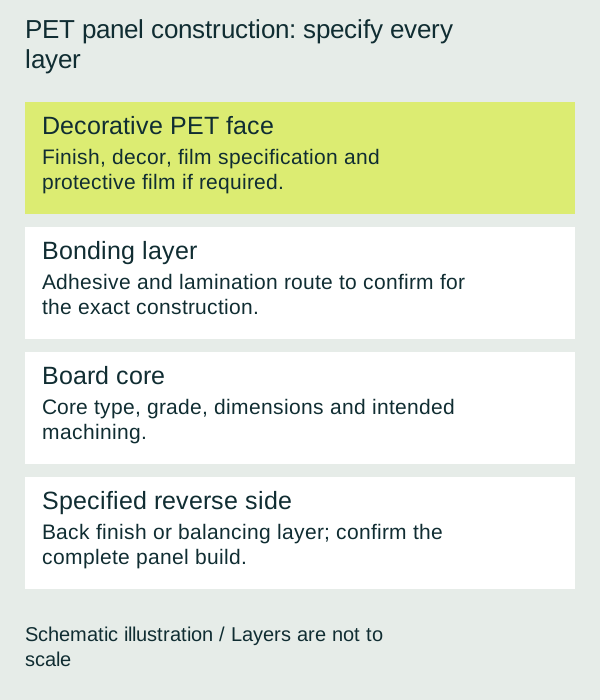
Identify each layer
Ask for PET film or facing details, the bonding specification, core type and grade, total panel thickness and reverse-side construction. A film sample and a finished board sample answer different questions. Request the relevant finished construction for your cabinet door or furniture component.
Film thickness is only one parameter
PET film thickness is a specification parameter, not a standalone quality grade. A thicker film does not, by itself, establish better bonding, a flatter core or a more consistent finish. Compare the construction and the evidence behind it rather than buying on one thickness value. Available specifications vary by product and project requirements.
Brand and series names need evidence
Different brands, series and processes may use different constructions. A marketing name is not a verified durability ranking. Request a product identifier, technical information and a sample representing the supply being quoted.
Evaluate high gloss, matte and woodgrain finishes
High gloss
Inspect surface uniformity, visible waviness, inclusions and reflections under agreed lighting. Compare adjacent samples for colour and sheen. Establish whether protective film is included and how it should be handled during processing.
Matte
Review texture and sheen as well as colour. Ask for product-specific support for any anti-fingerprint, scratch-resistance or easy-cleaning claim. Appearance alone cannot verify those properties.
Woodgrain
Specify decor reference, texture, grain direction and how adjacent doors or panels should align. Agree acceptable visual variation and record the sample or decor code in the component schedule. A photograph is useful for shortlisting; physical samples are better for final appearance approval.
Inspect the surface, bond, core and edges
Surface consistency and flatness
Check colour variation, gloss or texture consistency, bubbles and visible defects. Review panel flatness under an agreed support and inspection method. Define the acceptance criteria with the supplier before production, rather than deciding them after delivery.
Bonding and edge condition
Look for lifting, bubbles, gaps or damage at cut edges and corners. Ask how bonding will be checked for the selected film, adhesive and core. A visual inspection can identify some defects, but it is not a substitute for an agreed bond test where the application requires one.
Core quality
Confirm MDF or the alternative core, grade, thickness and intended machining. Review cut-edge condition and suitability for drilling, fixings and the proposed component size. Moisture performance depends on the complete panel construction, including the core, bonding, edges and exposure conditions. Do not infer moisture performance from the PET face alone.
Front and back construction
Record whether the reverse face is matching PET, another decorative finish or a specified balancing layer. Check the actual construction against the quote; similar appearance does not mean two samples have the same build. Discuss balance and stability for the intended component and environment. A balanced construction can help control panel stresses, but it does not by itself guarantee flatness or prevent warping.
Machining compatibility
For cut-to-size, drilling and edge banding, review a processed sample where practical. Confirm final dimensions, edging, hole locations and surface protection with the component schedule. Available processing methods are confirmed according to material, edge specification and production requirements.
Keep performance claims tied to the exact product
Scratch and moisture resistance
If scratch resistance, moisture resistance, heat behaviour or bond durability matters to the project, request supplier data or an actual product test with its method and conditions. A test for one film, core or product series may not apply to another combination. No universal performance number is implied by the term PET panel.
Check samples against production
Keep an approved sample identified by product code, finish, core, front/back construction and approval date. Agree checks for batch colour, flatness, bond appearance and processed edges. Specify whether a first-part or pre-shipment sample is required and how deviations will be reviewed.
Build a useful PET panel RFQ
Send a specification, not only a finish name
Include finish or decor, core and grade, dimensions, total thickness, front/back build, quantities, processing, destination and packing requirements. List any performance evidence needed for approval. Sample availability, commercial terms and the final supply scope require written confirmation.
Buyer checklist
- Surface uniformity and visible defects
- Colour, sheen and texture consistency
- Flatness and dimensional acceptance criteria
- Bonding evidence and visible bond defects
- Cut-edge and edge-banding condition
- Core identity and machining suitability
- Front/back construction
- Approved sample and production consistency
Discuss your sourcing requirements
Planning a PET panel project? Send your required finish, core, thickness, quantity and destination for review.